
Best Running Insoles: 5 Top Picks for Comfort, Support, and Performance
The best running insoles for most runners are the CURREX RUNPRO Insoles. They offer a strong balance of cushioning, stability, flexibility, and arch-specific support, with Low, Medium, and High profiles available. Their dynamic arch design and decoupled heel make them particularly appealing for runners who want more support without making their shoes feel excessively rigid. Independent testing from iRunFar also named the CURREX RUNPRO its overall best running insole in its 2026 guide.
Other excellent choices include the Superfeet Run Support for runners who prefer a more structured feel, PowerStep PULSE Maxx for runners seeking additional motion control, Tread Labs Pace 2 for firm support and long-term replaceability, and SOLE Active Medium for runners who want a moldable footbed. The right choice ultimately depends more on your arch profile, shoe volume, preferred cushioning, and the amount of support you need than on price alone.
Quick Comparison of the Best Running Insoles
| Product | Best For | Weight Range | Adjustment Type | Key Feature | Check Price |
| CURREX RUNPRO | Best overall | N/A | Low/Medium/High profile | Dynamic arch support | View on Amazon |
| Superfeet Run Support | Structured support | N/A | Low/Medium/High arch | EVOLyte stabilizer cap | View on Amazon |
| PowerStep PULSE Maxx | Overpronation support | N/A | Fixed support profile | Angled heel post | View on Amazon |
| Tread Labs Pace 2 | Firm support | N/A | 4 arch heights | Replaceable top covers | View on Amazon |
| SOLE Active Medium | Moldable support | N/A | Heat/wear moldable | Customizable orthopedic base | View on Amazon |
Best Running Insoles Reviewed
1. CURREX RUNPRO Insoles

Best for: Most runners looking for a balance of support, comfort, and natural movement
The CURREX RUNPRO is our top overall choice because it avoids going too far in either direction. It isn’t an extremely rigid orthotic, but it provides considerably more structure than the flat sockliner supplied with many running shoes.
CURREX offers the RUNPRO in Low, Medium, and High arch profiles, allowing runners to choose a model based on their foot shape. Its Dynamic Arch Technology is designed to move with the foot instead of simply holding it rigidly in one position. The insole also has a fully decoupled heel and dual-layer cushioning.
Key Features
- Low, Medium, and High arch profiles
- $59.95 current manufacturer price
- Dynamic Arch Technology
- Fully decoupled heel
- Dual-layer cushioning
- Targeted heel and forefoot cushioning
- Moisture-managing top layer
- Can be trimmed to fit
- 60-day guarantee
- Designed for road, trail, track, and cross-country running
Pros
- Excellent balance of support and flexibility
- Multiple arch profiles make fitting easier
- Designed specifically for running
- Good cushioning without an excessively bulky feel
- Suitable for road and trail use
Cons
- Requires choosing the correct arch profile
- May not provide enough rigid control for runners who specifically need a corrective orthotic
- Premium price compared with basic replacement insoles
Why We Recommend It
The RUNPRO is the easiest product here to recommend to the broadest range of runners. It combines a relatively natural feel with meaningful arch support, and the three profile options make it easier to personalize the fit. iRunFar’s 2026 testing also ranked it as its overall best running insole after testing models across different shoes and surfaces.
2. Superfeet Run Support
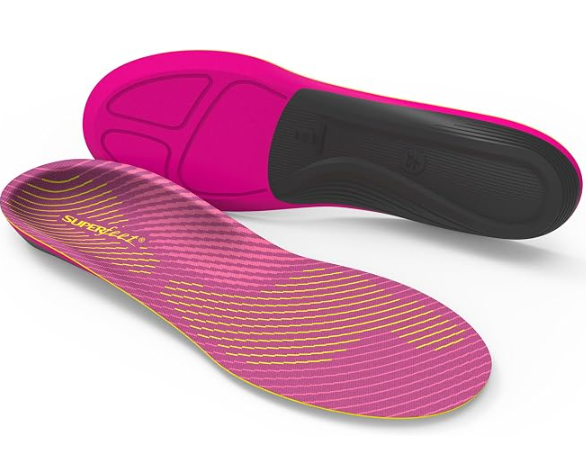
Best for: Runners who prefer a more structured, supportive feel
Superfeet has been making performance insoles for decades, and its current Run Support line is designed specifically around running footwear. The Run Support model combines a shaped heel cup, responsive support structure, and cushioning designed to work with athletic shoes.
The Run Support Medium Arch uses an EVOLyte carbon-fiber/polymer stabilizer cap and two layers of AeroSpring Rebound foam. Superfeet also offers Low and High Arch versions, which means runners aren’t forced into a one-size-fits-all arch shape.
Key Features
- Low, Medium, and High arch options
- $59.99 manufacturer price
- EVOLyte stabilizer cap
- AeroSpring Rebound foam
- Deep heel cup
- Mid-level cushioning
- Moisture-wicking top cover
- Designed for running and athletic shoes
- Trim-to-fit construction
Pros
- Strong heel and arch structure
- Multiple arch heights
- Good choice for runners who like firm support
- Durable construction
- Designed specifically for athletic footwear
Cons
- Structured feel won’t suit everyone
- Maximum thickness can affect shoe fit
- Requires careful arch-height selection
Why We Recommend It
Superfeet is a good alternative if the flexible feel of CURREX isn’t what you’re looking for. Its combination of heel containment, structured support, and responsive cushioning makes it particularly attractive to runners who want their replacement footbed to feel noticeably more supportive than the stock insole.
3. PowerStep PULSE Maxx

Best for: Runners who want firmer support and additional motion control
The PowerStep PULSE Maxx takes a more structured approach than the CURREX RUNPRO. It is designed for runners who want support around the arch and heel and is particularly targeted toward overpronation.
The PULSE Maxx uses a firm but flexible polypropylene support shell, deep heel cradle, and slightly angled heel post. Its dual-layer cushioning includes PowerStep’s ShockAbsorb Premium Foam, giving it a combination of support and cushioning rather than relying exclusively on a hard orthotic shell.
Key Features
- $59.95 manufacturer price
- Full-length design
- Firm but flexible support shell
- Deep heel cradle
- Slightly angled heel post
- Dual-layer cushioning
- ShockAbsorb Premium Foam
- Odor-control top fabric
- No trimming required
- 60-day guarantee
Pros
- Strong stability
- Useful option for runners seeking motion control
- Deep heel cradle
- Cushioned without being a soft-only insole
- Can move between compatible shoes
Cons
- Firmer feel than many running-specific insoles
- May feel excessive for runners who don’t need substantial support
- Less customizable than CURREX’s arch-profile system
Why We Recommend It
The PULSE Maxx is the better choice when stability is your priority. It doesn’t try to mimic the feel of a neutral stock shoe insert; instead, it provides a noticeable support structure under the arch and around the heel. That makes it worth considering for runners who know they prefer firmer support.
If you have persistent pain or a diagnosed foot condition, however, don’t assume an over-the-counter insole is automatically the right treatment. A podiatrist or qualified healthcare professional can help determine whether you need a specific orthotic design.
4. Tread Labs Pace 2

Best for: Runners who want firm support and a long-term replaceable design
Tread Labs takes a different approach to insole longevity. The Pace 2 combines a firm support base with a replaceable top cover, meaning you can replace the worn surface without necessarily replacing the entire support platform.
The 2026 Pace 2 is available in four arch heights: Low, Medium, High, and Extra High. Tread Labs lists the current price at $80 and describes the Pace 2 as its flagship insole for all-day performance. The design adds a Precision Heel Cushion and Friction-Control Pattern to the Pace platform.
Key Features
- $80 current manufacturer price
- Four arch heights
- Firm molded support
- Deep heel cup
- Replaceable top covers
- Precision Heel Cushion
- Friction-Control Pattern
- HSA/FSA eligible
- APMA-approved Pace 2 platform
- Designed for long-term use
Pros
- Excellent arch-height customization
- Firm, supportive platform
- Replaceable top covers can extend product life
- Deep heel cup
- Good option for runners who prefer structured support
Cons
- Most expensive option in this comparison
- Firm feel may require an adjustment period
- Not ideal for runners looking for a very soft, flexible insole
Why We Recommend It
The Pace 2 stands out because you’re investing in a system rather than a disposable footbed. If you run frequently and wear through top covers quickly, the replaceable-cover design can make more sense than continually buying complete insoles. It’s also one of the better choices for runners who need a very specific arch height.
5. SOLE Active Medium

Best for: Runners who want a moldable, customizable footbed
The SOLE Active Medium is different from the highly profile-specific CURREX and the firm motion-control approach of PowerStep. Its main selling point is its moldable orthopedic base, which can adapt to the user’s foot through heat molding or wear molding.
The Active Medium is intended for medium-fitting footwear, including running shoes, and combines a supportive base with medium cushioning. SOLE says the footbed can be heat molded at home or allowed to adapt through regular use.
Key Features
- Around $50 at major retailers
- Medium cushioning
- Moldable orthopedic base
- Heat or wear moldable
- Zero-drop design
- Deep heel cup
- Suitable for medium-fitting running shoes
- Durable EVA base
- Available in multiple shoe sizes
Pros
- Customizable fit
- Good balance of cushioning and support
- Useful across multiple sports
- Durable EVA base
- Competitive price
Cons
- Heat molding requires extra setup
- Medium thickness may not fit every running shoe
- Less running-specific than CURREX RUNPRO
Why We Recommend It
The SOLE Active Medium is a smart option if you want to customize the feel of the footbed rather than simply selecting a predefined arch profile. It can also work across several types of athletic footwear, making it appealing for people who use the same shoes for running, walking, gym sessions, and other activities.
Comparison Section
CURREX RUNPRO vs Superfeet Run Support vs PowerStep PULSE Maxx
The three most important differences between these insoles are how they support the foot, how much they change the feel of the shoe, and how much customization they offer.
| Category | CURREX RUNPRO | Superfeet Run Support | PowerStep PULSE Maxx |
| Overall feel | Dynamic/flexible | Structured/responsive | Firm/stable |
| Arch options | Low/Medium/High | Low/Medium/High | More fixed support design |
| Heel support | Decoupled heel | Deep heel cup | Deep heel cradle |
| Cushioning | Dual-layer | Mid-level | Dual-layer |
| Main advantage | Natural movement | Structured support | Motion control |
Size and Fit
CURREX offers the broadest simple profile selection with Low, Medium, and High versions. Superfeet also offers multiple arch heights, while PowerStep focuses more on a particular support architecture rather than allowing you to select from several dynamic arch profiles.
Before buying any of them, check whether your running shoe has a removable factory insole. Most replacement footbeds are designed to take the place of the original liner rather than sit on top of it.
Adjustment Mechanism
There isn’t a mechanical “adjustment” mechanism like you’d find on adjustable dumbbells. Instead, running insoles are adjusted through arch profile selection, trimming, or molding.
CURREX and Superfeet rely heavily on choosing the correct profile. SOLE adds heat molding, while Tread Labs provides four arch-height choices. This makes fitting arguably more important than choosing the brand with the highest marketing claims.
Durability
All five are designed as performance replacement insoles rather than disposable foam liners. Tread Labs has the clearest long-term approach because its Pace system uses replaceable top covers. CURREX, Superfeet, PowerStep, and SOLE are more conventional complete-footbed designs.
Price
The CURREX, Superfeet, and PowerStep options are all clustered around $60, making the decision more about fit and feel than price. Tread Labs Pace 2 costs more initially at $80, while SOLE Active Medium is generally less expensive.
For most runners, spending another 10–20 isn’t worthwhile if the more expensive insole has the wrong arch shape.
Buying Guide
Choosing the best running insoles isn’t simply a matter of finding the most expensive pair. Your arch height, running shoe, foot volume, cushioning preference, and desired level of support all affect the result.
Weight Range
Unlike adjustable weights or home gym equipment, insoles aren’t selected according to a specific weight range. However, your body weight can influence how a footbed feels under load.
A lighter runner may prefer a moderately flexible insole, while a heavier runner may prefer a more substantial support structure. This isn’t a strict rule, though. Comfort and fit should take priority over choosing an insole based solely on body weight.
Arch Height
Arch height is one of the most important variables.
Low arches: Look for an insole designed to support a relatively low arch without creating a painful pressure point.
Medium arches: Medium-profile insoles are a sensible starting point for many runners who don’t know their arch type.
High arches: A high-arch profile can provide more continuous contact and support, but an overly aggressive arch can feel uncomfortable.
CURREX and Superfeet both offer multiple arch profiles, while Tread Labs offers four options.
If you’re uncertain, use the manufacturer’s fitting guide rather than guessing based solely on how your arch looks.
Adjustment Mechanism
There are three common ways aftermarket running insoles are fitted.
Profile selection: You select Low, Medium, or High based on the manufacturer’s fitting process. CURREX and Superfeet use this approach.
Moldable footbeds: SOLE’s Active Medium can be heat molded or allowed to conform gradually through wear.
Replaceable systems: Tread Labs uses a durable support platform with replaceable covers, giving you a different way to manage long-term wear.
Size and Storage
Running shoes don’t always have enough internal volume for a thick aftermarket insole. If your shoe already fits snugly across the top of your foot, replacing the factory sockliner with a thick insole can make the shoe feel tighter.
Whenever possible:
- Remove the factory insole.
- Compare its shape and thickness with the replacement.
- Check that the replacement doesn’t crowd your toes.
- Make sure your heel remains securely seated.
- Walk before attempting a long run.
This is particularly important with maximum-thickness or heavily structured models.
See our guide to the best home gym equipment for small spaces
Durability
Look for a firm support base, durable foam, a well-bonded top cover, and construction that resists compression.
But remember that even a premium insole eventually wears out. Signs that replacement may be appropriate include visible compression, a deformed heel cup, peeling material, or a noticeable change in support.
Tread Labs’ replaceable-cover system is particularly interesting for runners who want to keep the support base in service longer.

Cushioning vs Support
More cushioning isn’t automatically better.
A soft insole can feel comfortable immediately, but some runners prefer the controlled feeling of a firmer platform. Conversely, a highly structured insole can feel intrusive if your feet don’t need that degree of support.
Think about what you want the insole to change:
- More comfort: Consider a cushioned running-specific model.
- More arch support: Look at CURREX, Superfeet, or Tread Labs.
- More stability: Consider PowerStep PULSE Maxx.
- Customizable fit: Consider SOLE Active Medium.
- Long-term replaceability: Consider Tread Labs Pace 2.
Do You Actually Need Running Insoles?
Not necessarily.
If your factory insoles are comfortable, your shoes fit correctly, and you have no reason to change the feel of the shoe, an aftermarket insole may not provide enough benefit to justify the cost.
Insoles are most useful when you’re trying to address a specific fit or comfort issue, such as inadequate arch support, insufficient cushioning, or a poorly matched stock footbed.
If running pain is persistent, worsening, or affecting your ability to exercise, don’t keep changing insoles indefinitely. A qualified healthcare professional can help determine whether footwear, training load, biomechanics, or another issue is contributing to the problem.
FAQs
Are running insoles worth it?
They can be, particularly if the factory footbed doesn’t provide the comfort or support you need. The benefit varies substantially from person to person, so a $60 insole isn’t automatically better than the original insert in your running shoes.
How do I know what arch height I need?
Use the manufacturer’s fitting guide whenever possible. CURREX, Superfeet, and Tread Labs all offer multiple arch profiles, while SOLE uses a moldable design that can adapt to the foot.
Can running insoles help with foot pain?
They may improve comfort or change how your foot is supported inside the shoe, but they aren’t guaranteed to resolve pain. If you have persistent or significant pain, particularly after changing training or footwear, seek advice from a qualified healthcare professional rather than relying solely on an aftermarket insole.
Do running insoles make shoes more comfortable?
They can, but comfort depends on getting the right thickness, arch profile, and cushioning level. An insole that is too thick or has an arch that doesn’t match your foot can actually make a comfortable shoe feel worse.
How often should running insoles be replaced?
There isn’t one universal replacement schedule. Replace them when the cushioning or support becomes visibly compressed, the top material deteriorates, or the footbed no longer feels as supportive as it did when new. Runners who log high mileage may need replacements more frequently than occasional runners.
Can I use running insoles in gym shoes?
Yes, provided the insole fits the footwear correctly and doesn’t create excessive pressure or reduce stability. CURREX RUNPRO, Superfeet Run Support, and SOLE Active Medium can all be used in athletic footwear, although a dedicated gym shoe may have different fit and support requirements.
Bottom Line
For most runners, CURREX RUNPRO is the best running insole overall because it combines dynamic support, cushioning, multiple arch profiles, and a running-specific design without feeling excessively rigid.
Choose Superfeet Run Support if you prefer structured support, PowerStep PULSE Maxx if stability and motion control are your priorities, Tread Labs Pace 2 if long-term replaceability matters, or SOLE Active Medium if you want a moldable footbed.
The best running insole isn’t necessarily the one with the most support or the highest price. It’s the one that fits your foot, fits your running shoe, and improves the way the shoe feels mile after mile.