
Best Running Watch 2026: 5 Top GPS Watches Compared for Every Runner
If you are shopping for the best running watch, the right choice depends less on having the most features and more on matching the watch to how you actually train. GPS accuracy, battery life, training analytics, comfort, navigation, smartphone compatibility, and price all matter.
For this guide, we compared five strong 2026 options: the Garmin Forerunner 570, COROS PACE 4, Apple Watch Ultra 3, Polar Vantage M3, and Suunto Race S. Current expert roundups also place the Garmin Forerunner 570 among the leading running watches, while the COROS PACE 4 stands out for its low weight and long GPS battery life.
The Garmin Forerunner 570 is our top pick for the best running watch for most runners in 2026. It combines accurate multi-band GPS, advanced training and recovery features, running dynamics, music, Garmin Coach, Training Readiness, and a bright AMOLED display without reaching the price or bulk of Garmin’s most expensive models. The 47mm version weighs 50g and offers up to 18 hours of GPS-only battery life or 14 hours in multi-band mode.
If value and battery life matter most, the COROS PACE 4 is the standout alternative. It weighs only 32g with its nylon band, provides up to 41 hours of GPS use, and costs $249 at launch. Apple Watch Ultra 3 is the better choice for iPhone users who want a premium smartwatch alongside strong running features, while the Polar Vantage M3 and Suunto Race S are excellent options for runners who prioritize recovery analysis or outdoor navigation.
Quick Comparison of the Best Running Watches for Training, Racing, and Everyday Fitness.
| Product | Best For | Weight Range | Adjustment Type | Key Feature | Check Price |
| Garmin Forerunner 570 | Most runners | 42g / 50g | Silicone/quick-release band | Advanced training analytics + multi-band GPS | View on Amazon |
| COROS PACE 4 | Value + battery life | 32g / 40g | Nylon or silicone band | 41-hour GPS battery | View on Amazon |
| Apple Watch Ultra 3 | iPhone users | 61.6–61.8g | Multiple band styles | Premium smartwatch + dual-frequency GPS | View on Amazon |
| Polar Vantage M3 | Training + recovery | 53g | Silicone quick-release | Recovery tools + offline maps | View on Amazon |
| Suunto Race S | Trail runners | 60g | Silicone band | Offline maps + 30-hour multi-band GPS | View on Amazon |
Product Reviews: Best Running Watches
1. Garmin Forerunner 570

Best for: Most runners, from serious beginners to marathon and triathlon trainees
The Garmin Forerunner 570 is the most balanced choice in this group. Garmin offers it in 42mm and 47mm sizes, so runners can choose between a smaller, lighter watch and a larger display. The 47mm model weighs 50g, while the 42mm version weighs 42g.
Key Features
- AMOLED touchscreen display
- Multi-band GPS and SatIQ technology
- Garmin Coach training plans
- Training Readiness and Training Status
- Wrist-based running dynamics
- Wrist-based running power
- Music storage
- Garmin Pay
- Incident Detection and LiveTrack
- Up to 11 days of smartwatch battery on the 47mm version
- Up to 14 hours in All-Systems + Multi-Band GPS mode on the 47mm version
Pros
- Excellent combination of running and recovery data
- Strong GPS performance
- Two case sizes
- Bright, easy-to-read AMOLED screen
- Mature Garmin Connect training ecosystem
Cons
- More expensive than the COROS PACE 4
- GPS battery life is shorter than COROS and Suunto alternatives
- Built-in maps are reserved for the more expensive Forerunner 970
Why We Recommend It
The Forerunner 570 does a particularly good job of avoiding the two extremes of running-watch design: it is neither a stripped-down beginner tracker nor an oversized expedition watch packed with features most road runners never use.
It is especially compelling for runners who want training guidance rather than just a record of distance and pace. Garmin’s Training Readiness, Training Status, running dynamics, suggested workouts, and Garmin Coach tools can turn raw workout data into something much more actionable.
2. COROS PACE 4

Best for: Runners who want maximum battery life and low weight for the money
The COROS PACE 4 is the watch to consider if you dislike charging. The standard version weighs only 32g with a nylon band or 40g with silicone, while providing up to 41 hours of GPS tracking and up to 19 days of daily use.
Key Features
- 1.2-inch AMOLED touchscreen
- Dual-frequency, All-Systems GPS
- Up to 41 hours of GPS battery
- Up to 19 days of daily use
- Race Predictor
- Virtual Pacer
- Personalized marathon plans
- Breadcrumb navigation
- Running Fitness metrics
- Built-in microphone for training notes
- Sleep, HRV, recovery, and activity tracking
- Strava, TrainingPeaks, and other platform integration
Pros
- Extremely light
- Excellent battery life
- Competitive $249 starting price
- AMOLED display
- Strong running-specific feature set
Cons
- Less comprehensive smartwatch functionality than Apple Watch
- Training ecosystem is not as mature or broad as Garmin’s
- No traditional onboard mapping system comparable with the Suunto Race S
Why We Recommend It
The PACE 4 makes a strong argument that you don’t need to spend $500 or more for a capable running watch. It combines a lightweight design with the kind of battery life that makes long training blocks and races less stressful.
The 41-hour GPS rating is particularly attractive to marathoners, ultrarunners, and runners who simply don’t want to charge their watch every night. COROS also keeps the watch focused: the interface emphasizes training, recovery, navigation, and performance instead of trying to replicate every smartphone function.
3. Apple Watch Ultra 3

Best for: iPhone users who want one watch for running, health, communication, and everyday life
The Apple Watch Ultra 3 is the most smartwatch-oriented option in this comparison. It has a 49mm titanium case, weighs 61.6g in natural titanium or 61.8g in black, and includes precision dual-frequency GPS, cellular connectivity, satellite communication, and a large always-on OLED display.
Key Features
- 49mm Grade 5 titanium case
- Precision dual-frequency GPS
- Always-on OLED display
- Up to 3,000 nits peak brightness
- ECG and advanced heart-rate sensors
- Training Load and Workout Effort
- Running power, cadence, stride length, and vertical oscillation
- Cellular and satellite connectivity
- Emergency SOS via satellite
- Up to 42 hours of normal use
- Up to 72 hours in Low Power Mode
Pros
- Excellent smartwatch experience
- Best choice for Apple ecosystem users
- Large, bright, rugged display
- Strong safety and communication features
- Dual-frequency GPS
Cons
- Expensive
- Heavy compared with dedicated running watches
- iPhone-centric ecosystem
- Dedicated Garmin and COROS watches generally offer more training-focused battery endurance
Why We Recommend It
For an iPhone owner, the Ultra 3 can replace several devices at once. It is a running watch, smartwatch, communication device, safety tool, and everyday health tracker.
Its biggest advantage is not necessarily raw running functionality. Instead, it offers a polished combination of running metrics and everyday features that dedicated sports watches don’t always match. Apple also lists running features including customizable workouts, training load, race routes, pacing, running power, cadence, and multisport workouts.
4. Polar Vantage M3

Best for: Runners who care about recovery, training load, and multisport features
The Polar Vantage M3 is a compact multisport watch with a 53g weight, 44.7mm case width, 1.28-inch AMOLED display, and dual-frequency GPS. Polar also includes offline maps, route guidance, training-load tools, sleep tracking, and a broad collection of sport profiles.
Key Features
- 1.28-inch AMOLED touchscreen
- Dual-frequency GPS
- Offline maps and route guidance
- Polar Elixir biosensing
- Training Load Pro
- Recovery Pro
- Nightly Recharge
- Wrist-based running power
- Running Performance Test
- Over 150 sport profiles
- Up to 30 hours in Performance Training mode
- Up to 70 hours in Eco Training mode
- Up to 7 days in smartwatch mode
Pros
- Excellent recovery and training-load analysis
- Compact design
- Offline maps
- Strong multisport capabilities
- Long battery life
Cons
- Smartwatch functionality is more limited than Apple Watch
- Interface can require more learning
- Not as lightweight as the COROS PACE 4
Why We Recommend It
Polar’s strength is the depth of its training and recovery ecosystem. The Vantage M3 doesn’t just tell you how far you ran; it attempts to put training stress, sleep, recovery, and performance into a broader picture.
It is a particularly good fit for runners who also cycle, swim, strength train, or participate in several types of endurance training. Polar lists tools such as Training Load Pro, Recovery Pro, FitSpark, FuelWise, and wrist-based running power among its core features.
5. Suunto Race S

Best for: Trail runners, hikers, and athletes who need navigation
The Suunto Race S is the most compelling option here for runners who regularly leave paved roads. Its 1.32-inch AMOLED display supports offline maps, while the watch offers multi-band GPS and up to 30 hours of training battery life at maximum GPS accuracy.
Key Features
- 1.32-inch AMOLED display
- Offline maps
- Digital crown
- Multi-band GPS
- 115+ sport modes
- HRV-based recovery metrics
- Training load and progress analysis
- AI Coach
- 60g weight
- 50m water resistance
- Up to 30 hours in multi-band training mode
- Up to 40 hours in single-band training mode
- Up to 120 hours in power-saving GPS modes
Pros
- Excellent navigation features
- Offline maps included
- Strong battery endurance
- Bright AMOLED screen
- Good choice for trail and outdoor athletes
Cons
- Heavier than COROS
- Smartwatch features are less comprehensive than Apple Watch
- More navigation-focused than many road runners need
Why We Recommend It
If your definition of running includes mountain trails, unfamiliar routes, or long outdoor adventures, the Race S becomes much more attractive. Offline maps can be a genuinely useful feature when phone reception is unreliable.
The combination of 30 hours of high-accuracy GPS and up to 120 hours in power-saving modes also gives it plenty of flexibility for long-distance activities.
Comparison Section
Garmin Forerunner 570 vs COROS PACE 4 vs Suunto Race S
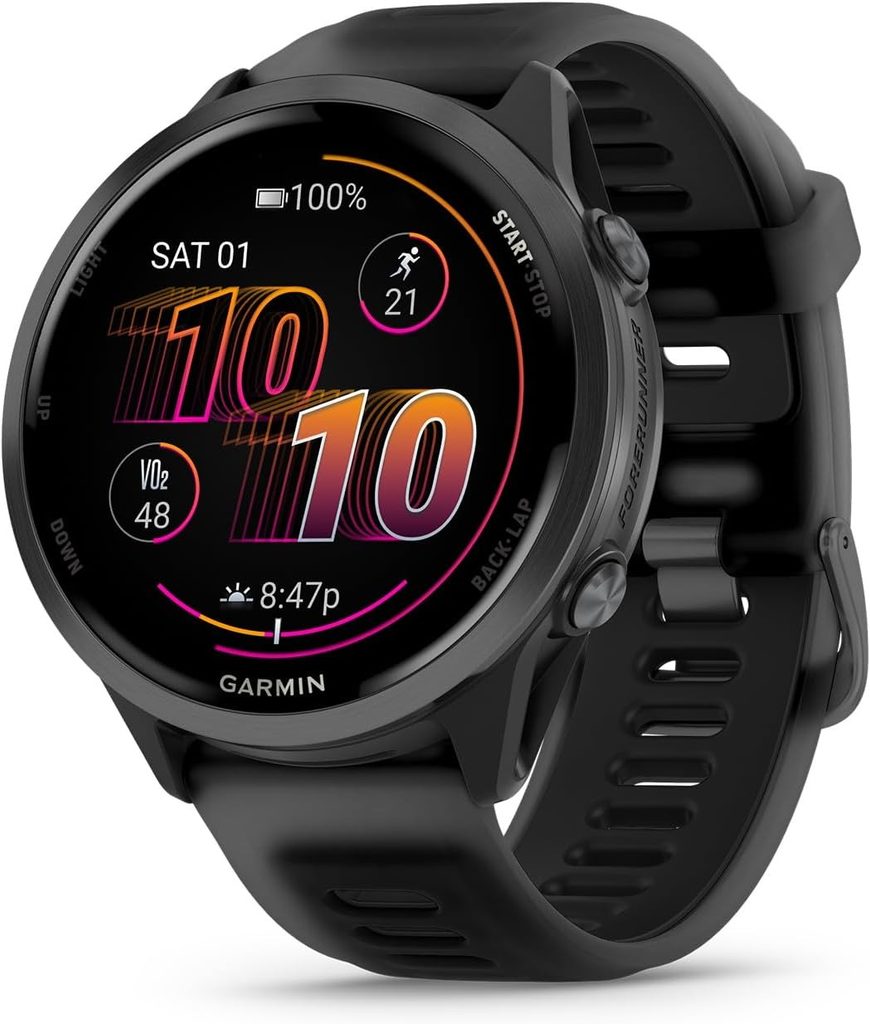


If you’re narrowing the list to the three most interesting dedicated running watches, the decision becomes relatively straightforward.
| Category | Garmin Forerunner 570 | COROS PACE 4 | Suunto Race S |
| Weight | 42g / 50g | 32g / 40g | 60g |
| GPS battery | Up to 18h GPS-only / 14h multi-band | Up to 41h | Up to 30h multi-band |
| Display | AMOLED | AMOLED | AMOLED |
| Maps | No full onboard maps | Breadcrumb navigation | Offline maps |
| Training | Excellent | Excellent | Excellent |
| Smartwatch features | Very good | Basic | Basic |
| Best advantage | Training ecosystem | Battery + weight | Navigation |
Size: The PACE 4 is the easiest to forget on your wrist because it is dramatically lighter. The Garmin gives you a choice of 42mm and 47mm cases, while the Race S uses a 45mm case and weighs 60g.
Adjustment mechanism: All three use conventional watch bands rather than a proprietary weight or dial system. The important difference is the feel: COROS emphasizes a thin, low-profile design, Garmin offers two case sizes, and Suunto combines a silicone strap with a digital crown for navigation.
Durability: All three are designed for regular sports use. Garmin uses an aluminum bezel and Gorilla Glass, COROS uses a fiber-reinforced polymer construction, and the Race S combines a stainless-steel bezel with Gorilla Glass.
Price: The PACE 4 is the clear value play at $249. The Race S is positioned at $349, while the Forerunner 570 starts at $549.99. That price gap is significant, but Garmin earns part of it through its deeper training and smartwatch ecosystem.
Ease of use: COROS is attractive if you want a focused training interface. Garmin has more features and therefore more menus to learn. Suunto’s digital crown and maps make it especially useful when navigating trails.
Buying Guide
Choosing the best running watch starts with your training habits rather than the feature list.
GPS Accuracy
For most runners, GPS is the foundation of the watch.
Dual-frequency or multi-band GPS can improve positioning in environments where satellite signals are affected by tall buildings, trees, or other obstacles. That can matter when you use pace and distance data for intervals or race training.
If you mostly run in open suburban areas, you may not need to pay a premium specifically for multi-band GPS. For urban runners, trail runners, and anyone who races frequently, however, it is a worthwhile feature.
Battery Life
Battery life is one of the easiest specifications to misunderstand.
Manufacturers normally quote different figures for smartwatch use, GPS-only tracking, high-accuracy GPS, and GPS with music. A watch that lasts 10 days as a smartwatch may provide substantially fewer hours when recording a GPS workout.
As a rule, look for at least 20–30% more GPS battery life than your longest expected activity. That gives you some safety margin for cold temperatures, navigation, music, or other battery-draining functions.
For example:
- Regular 30–60 minute runners can comfortably use most modern GPS watches.
- Marathon runners should look for several hours of GPS headroom beyond their expected finish time.
- Ultra runners should prioritize watches such as the COROS PACE 4 or Suunto Race S with substantially longer GPS endurance.
- Heavy smartwatch users may prefer Apple Watch Ultra 3’s large everyday battery capacity.
Display
AMOLED displays are now common on premium running watches because they are bright, colorful, and easy to read.
The trade-off is power consumption. A high-resolution AMOLED screen can use more energy than older memory-in-pixel displays, although newer watches have improved considerably.
Think about how you run:
- Road runner: AMOLED is excellent.
- Night runner: Brightness and an always-on option can be useful.
- Trail runner: Screen brightness and map readability become more important.
- Long-distance runner: Battery-saving display options matter more.
Training Features
Beginners do not necessarily need hundreds of metrics.
A useful running watch should at minimum provide:
- Distance
- Pace
- GPS route
- Heart rate
- Lap/split information
- Workout intervals
- Basic recovery information
More experienced runners may benefit from:
- Training load
- Training readiness
- HRV
- Running power
- Race predictions
- Structured workouts
- Training plans
- Recovery recommendations
The Garmin Forerunner 570 is particularly strong here, while Polar offers a similarly deep approach centered on training load and recovery.
Weight and Comfort
A watch that feels great for five minutes in a store may feel very different after a two-hour run.
The COROS PACE 4 is particularly impressive at just 32g with its nylon band. Garmin’s 42mm Forerunner 570 is also relatively light at 42g. By contrast, the Apple Watch Ultra 3 weighs more than 60g before considering the band.
If you have smaller wrists or dislike wearing a watch overnight, pay close attention to both weight and case diameter.
Smartwatch Features
Ask yourself whether your running watch needs to replace your smartwatch.
If you want calls, messaging, apps, cellular connectivity, music, payments, and safety features, the Apple Watch Ultra 3 is compelling.
If you mainly want training data, Garmin and COROS make more sense. Their dedicated sports ecosystems generally put running metrics and endurance training ahead of general-purpose smartwatch features.
Maps and Navigation
Maps are not essential for a runner who repeats the same neighborhood routes.
They become much more valuable for:
- Trail running
- Hiking
- Ultra-distance races
- Travel
- Unfamiliar city routes
- Navigation without a phone
The Suunto Race S is particularly attractive because offline maps are built into the experience.
See our guide to the best home gym equipment for small spaces

Durability
Look for a case and screen that can handle regular contact with sweat, equipment, doors, bags, and outdoor environments.
For most runners, Gorilla Glass and a quality polymer or aluminum case are sufficient. Trail and adventure athletes may want stronger materials, higher water resistance, sapphire glass, or a more rugged construction.
Water resistance is also worth checking if you swim, run in heavy rain, or regularly train outdoors. Remember that water resistance ratings do not mean every watch is designed for every type of diving or water activity.
Price and Value
The most expensive watch is not automatically the best running watch.
A $249 COROS PACE 4 can make more sense than a $799 Apple Watch Ultra 3 if your only goal is tracking runs and improving endurance. Conversely, an iPhone user who wants cellular communication, emergency features, apps, and a premium smartwatch may get considerably more value from the Apple.
The best purchase is the one whose features you will actually use.
FAQs
Are running watches worth it?
Yes, particularly if you train consistently or have a specific performance goal. A good running watch can automatically record pace, distance, heart rate, GPS route, workouts, and recovery information. The biggest benefit is having your training history in one place so you can identify progress and adjust your workouts.
How much should I spend on a running watch?
Most runners do not need to spend $500 or more. The COROS PACE 4 provides a strong feature set for $249, while the Garmin Forerunner 570 costs substantially more but adds deeper training and smartwatch functionality.
Is Garmin better than COROS for running?
Neither is universally better. Garmin generally has the broader training ecosystem and more smartwatch functionality, while COROS is especially competitive on weight, battery life, and value. For runners who primarily want long battery life and focused training tools, COROS can be the better buy.
Is the Apple Watch Ultra 3 good for running?
Yes. The Apple Watch Ultra 3 includes precision dual-frequency GPS and a substantial set of running metrics, including pace, cadence, running power, training load, race routes, and customizable workouts. It is particularly attractive for iPhone users who want a smartwatch that is also a capable running computer.
Do I need dual-frequency GPS?
Not necessarily. It is most useful for runners who train around tall buildings, dense tree cover, mountains, or other environments where GPS signals can be disrupted. If you primarily run in open areas, a high-quality single-frequency GPS system can still be perfectly adequate.
What is the best running watch for marathon training?
For most marathon trainees, the Garmin Forerunner 570 is the strongest all-around choice because of its structured workouts, training readiness, training status, running dynamics, GPS, and Garmin Coach ecosystem. If battery life and low weight are higher priorities, the COROS PACE 4 is an excellent alternative, with up to 41 hours of GPS battery life.
Final Verdict
For the majority of runners, the Garmin Forerunner 570 is the best running watch because it delivers the most complete balance of GPS accuracy, training analytics, comfort, battery life, and everyday features.
But it is not the automatic choice for everyone. Choose the COROS PACE 4 for exceptional battery life and low weight, the Apple Watch Ultra 3 if you’re deeply invested in the iPhone ecosystem, the Polar Vantage M3 for recovery-focused training, or the Suunto Race S if maps and trail navigation are high priorities.
The smartest purchase is not the watch with the longest specification sheet. It is the one whose training features, battery life, navigation, and ecosystem fit the way you actually run.