
Best Cycling Computer in 2026: 5 GPS Bike Computers Compared
The Garmin Edge 850 is our top pick for the best cycling computer for most riders. It combines a compact 2.7-inch color touchscreen with physical controls, advanced GPS positioning, detailed cycling maps, extensive training features, smart navigation, safety tools, and a relatively compact 113g design. Current BikeRadar testing also ranks the Edge 850 as its best overall bike computer.
The Garmin Edge 1050 is the better premium choice if you want a much larger display and Garmin’s most comprehensive feature set. The Wahoo ELEMNT ROAM 3 is an excellent navigation-focused alternative, while the lightweight Wahoo ELEMNT BOLT 3 makes more sense for racing and riders who prefer a compact computer. The Garmin Edge 840 is the value-oriented Garmin option and can provide many of the features serious cyclists want for less money.
Quick Comparison of the Best Cycling Computers for Road Cycling, Gravel, Training, Navigation, Racing, Commuting, and Long-distance Riding.
| Product | Best For | Weight | Adjustment / Controls | Key Feature | Check Price |
| Garmin Edge 850 | Best overall | 113g | Touchscreen + buttons | Compact premium training and navigation | View on Amazon |
| Garmin Edge 1050 | Best premium | 161g | Touchscreen + buttons | Large 3.5-inch display | View on Amazon |
| Wahoo ELEMNT ROAM 3 | Best navigation | 109g | Touchscreen + buttons | Large anti-glare display | View on Amazon |
| Wahoo ELEMNT BOLT 3 | Best compact | 84g | Physical buttons | Lightweight race-focused design | View on Amazon |
| Garmin Edge 840 | Best Garmin value | 84g | Touchscreen + buttons | Advanced features in a compact body | View on Amazon |
Product Reviews: Best Cycling Computers
1. Garmin Edge 850
Best for: Most serious cyclists
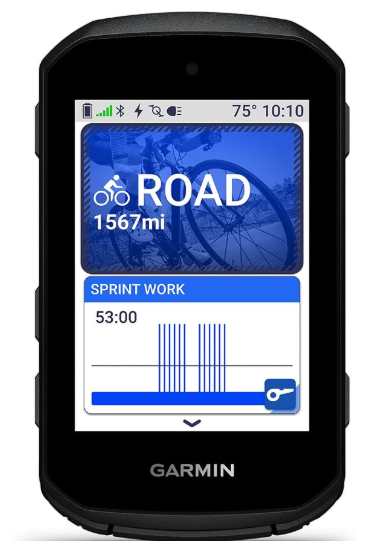
The Garmin Edge 850 earns our top spot because it provides the features most riders actually want without becoming as large as Garmin’s flagship Edge 1050.
Its 2.7-inch color touchscreen is paired with physical buttons, giving riders two ways to control the computer. That combination is useful when conditions change—for example, using the touchscreen when stopped and physical buttons when riding in rain or wearing gloves.
Garmin equips the Edge 850 with multi-band GNSS, cycling maps, training tools, ClimbPro, smart fueling features, Garmin Pay, GroupRide capabilities, incident detection, and compatibility with Garmin’s Varia radar and lighting ecosystem. Garmin lists the computer at 113g with up to 12 hours of battery life in demanding use and up to 36 hours in battery-saver mode.
Key Features
- 2.7-inch color touchscreen
- Physical control buttons
- 113g weight
- Multi-band GNSS
- Detailed cycling maps
- ClimbPro
- Cycling Coach
- Smart fueling alerts
- Garmin Pay
- GroupRide
- Incident detection
- Varia radar compatibility
- IPX7 water resistance
Pros
- Excellent balance of size and features
- Touchscreen plus physical buttons
- Detailed navigation
- Extensive training functions
- Strong safety ecosystem
- Compact enough for road and gravel bikes
Cons
- Expensive
- Battery life isn’t class-leading
- Feature-rich interface can take time to learn
Why We Recommend It
The Edge 850 is the best choice if you want one cycling computer that can do almost everything.
It’s equally useful for structured training, navigation, group rides, commuting, road cycling and gravel. Its smaller footprint also makes it easier to recommend than the Edge 1050 for riders who want to keep their handlebars relatively uncluttered.
2. Garmin Edge 1050
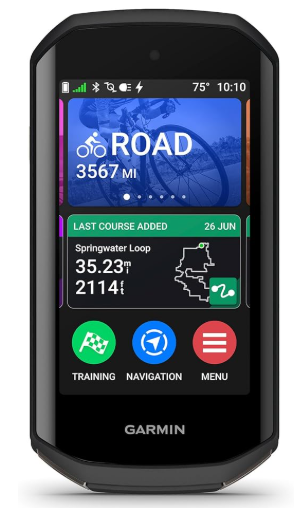
Best for: Riders who want the largest display and maximum Garmin features
The Garmin Edge 1050 is the premium choice in this group.
Its major advantage is the large 3.5-inch color touchscreen. That extra screen real estate makes maps easier to read and gives you more room for data fields.
Garmin rates the Edge 1050 at 161g and up to 20 hours of battery life in demanding use, or up to 60 hours in battery-saver mode. It also includes a built-in speaker, bike bell, Garmin Pay, road-hazard alerts, GroupRide features and advanced training functions.
Key Features
- 3.5-inch color touchscreen
- 161g weight
- Detailed cycling maps
- Up to 20 hours demanding-use battery
- Up to 60 hours battery-saver mode
- Built-in speaker
- Electronic bike bell
- Garmin Pay
- Road-hazard alerts
- GroupRide
- Advanced training metrics
- 64GB storage
Pros
- Excellent large display
- Outstanding navigation
- Extensive training features
- Strong connectivity
- Excellent map visibility
- Premium build
Cons
- Expensive
- Larger and heavier than the Edge 850
- More features than many casual riders need
Why We Recommend It
Choose the Edge 1050 when screen size is more important than minimizing weight and handlebar space.
It’s particularly useful for riders who frequently navigate unfamiliar routes or want to view numerous metrics at once.
3. Wahoo ELEMNT ROAM 3

Best for: Navigation and adventure riding
The Wahoo ELEMNT ROAM 3 is one of the best alternatives to Garmin.
It has a 2.8-inch high-contrast touchscreen, physical controls, 64GB of storage and up to 25 hours of battery life. Wahoo designed it around easy-to-read navigation, route guidance and an interface that doesn’t require a lot of menu digging.
The ROAM 3 supports Bluetooth and ANT+ sensors and can connect with services including Strava, Komoot, RideWithGPS and TrainingPeaks.
Key Features
- 2.8-inch touchscreen
- 109g weight
- Up to 25 hours battery life
- 64GB storage
- Anti-glare display
- Turn-by-turn navigation
- On-device routing
- Smart rerouting
- Bluetooth
- ANT+
- IPX7 water resistance
Pros
- Excellent navigation
- Large, readable display
- Long battery life
- Touchscreen and buttons
- Easy route synchronization
- Strong third-party app compatibility
Cons
- Less comprehensive training ecosystem than Garmin
- Premium price
- Larger than the BOLT 3
Why We Recommend It
The ROAM 3 is especially attractive for riders who prioritize navigation without wanting an overly complicated interface.
It’s a strong option for touring, gravel, bikepacking, commuting and exploring unfamiliar roads.
4. Wahoo ELEMNT BOLT 3

Best for: Racing and riders who want a compact cycling computer
The Wahoo ELEMNT BOLT 3 is the compact option in our lineup.
Its 2.3-inch display is smaller than the screens on the Edge 1050 and ROAM 3, but that helps keep the computer small and lightweight. Wahoo lists the BOLT 3 at 84g with up to 20 hours of battery life.
The BOLT 3 also relies on physical buttons rather than a touchscreen. For some cyclists, that’s actually an advantage. Buttons are easier to operate with gloves and can be preferable during fast riding.
Key Features
- 2.3-inch color display
- 84g weight
- Up to 20 hours battery life
- Physical controls
- Dual-band GPS
- Turn-by-turn navigation
- On-device routing
- Wi-Fi
- Bluetooth
- ANT+
- IPX7 water resistance
Pros
- Very lightweight
- Compact design
- Excellent physical controls
- Good battery life
- Strong navigation
- Good value compared with flagship models
Cons
- Smaller screen
- No touchscreen
- Less information visible at once
Why We Recommend It
If you race or simply want a small cycling computer that doesn’t dominate your handlebars, the BOLT 3 is difficult to beat.
It’s also an attractive choice for cyclists who prefer physical buttons over touch controls.
5. Garmin Edge 840

Best for: Riders who want Garmin features at a lower price
The Garmin Edge 840 is the value-oriented choice in this comparison.
It isn’t Garmin’s newest compact model, but that doesn’t make it outdated. The Edge 840 still provides advanced navigation, multi-band GNSS, touchscreen and button controls, ClimbPro, adaptive coaching and extensive cycling metrics.
Garmin lists battery life at up to 26 hours in demanding conditions and up to 42 hours with battery saver on the current Edge 840 specifications.
Key Features
- Compact color touchscreen
- Physical buttons
- Multi-band GNSS
- Advanced cycling maps
- ClimbPro
- Adaptive coaching
- Power Guide
- Training status
- Performance metrics
- Garmin Varia compatibility
- Long battery life
Pros
- Excellent Garmin feature set
- Compact
- Touchscreen plus buttons
- Strong navigation
- Often discounted
- Excellent battery life
Cons
- Older than the Edge 850
- Interface isn’t as modern as the newest Garmin generation
- Premium price when not discounted
Why We Recommend It
The Edge 840 becomes particularly attractive when Amazon discounts it.
If you don’t need the newest Edge 850 hardware, the 840 can provide much of the Garmin experience for significantly less money. That makes it a smart choice for riders who care more about features per dollar than having the newest model.
Garmin Edge 850 vs Edge 1050 vs Wahoo ROAM 3
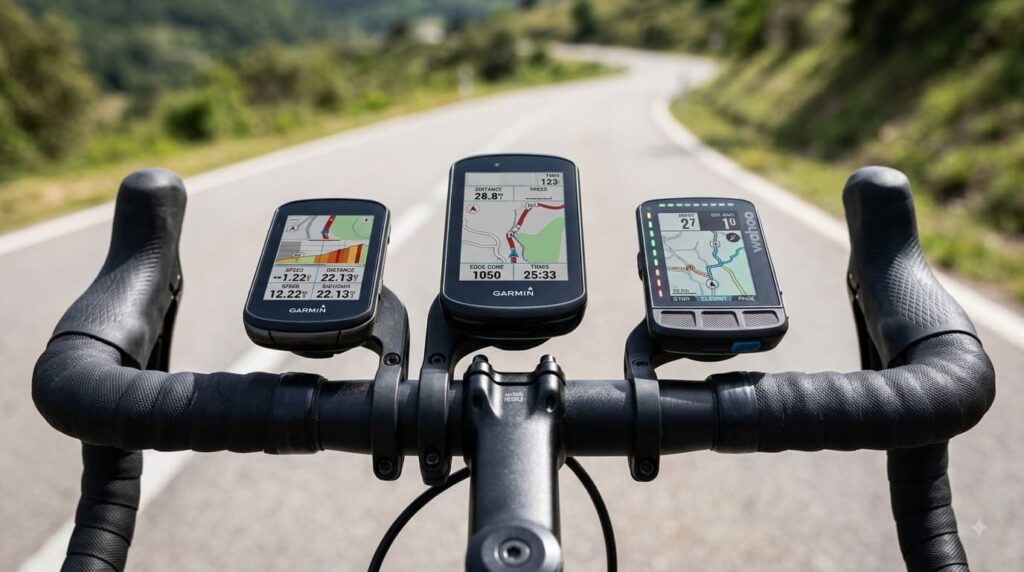
For most buyers, the biggest decision is between the Edge 850, Edge 1050 and ROAM 3.
| Feature | Garmin Edge 850 | Garmin Edge 1050 | Wahoo ROAM 3 |
| Screen | 2.7″ | 3.5″ | 2.8″ |
| Weight | 113g | 161g | 109g |
| Controls | Touch + buttons | Touch | Touch + buttons |
| Battery | Up to 12h demanding | Up to 20h demanding | Up to 25h |
| Navigation | Excellent | Excellent | Excellent |
| Training | Excellent | Excellent | Very good |
| Best advantage | Size/features | Large screen | Simple navigation |
Size
The Edge 1050 is clearly the largest option.
Its 3.5-inch screen is excellent for navigation, but it also takes up more space on the handlebars.
The Edge 850 offers a useful compromise. Its 2.7-inch screen is large enough for maps while maintaining a considerably smaller footprint.
The ROAM 3 has a slightly larger screen than the Edge 850 and weighs 109g. Wahoo also gives it up to 25 hours of battery life.
Controls
The Edge 850 and ROAM 3 offer both touchscreen functionality and physical controls.
That makes them particularly versatile.
The BOLT 3 takes the opposite approach and uses physical buttons. This can be preferable for riders who frequently ride in rain, cold weather or rough terrain.
Navigation
All three are strong navigation devices.
Garmin has an advantage if you want a broad training and cycling ecosystem alongside navigation.
Wahoo’s strength is its straightforward approach to routes and navigation. The ROAM 3 supports turn-by-turn directions, smart rerouting and integrations with major cycling platforms.
Price
The Edge 1050 sits at the premium end of the market.
The Edge 850 costs less while offering a more compact design.
The ROAM 3 generally sits between the premium Garmin and more compact BOLT 3 in terms of pricing.
If value is the priority, watch Amazon discounts on the Edge 840. Its 2026 Amazon pricing has dropped substantially below its $449.99 list price during promotions.
Buying Guide: How to Choose the Best Cycling Computer
A good cycling computer should match the way you ride.
You don’t necessarily need the most expensive model.
Display Size
A larger display is particularly helpful if navigation is your main reason for buying a cycling computer.
Choose a larger screen if you:
- Frequently follow unfamiliar routes
- Ride in cities
- Navigate gravel roads
- Need to see elevation information
- Want numerous data fields visible simultaneously
A smaller computer makes more sense for racing or riders who primarily need speed, power, heart rate and distance.
Battery Life
Consider your typical ride length.
For two- to four-hour rides, almost every modern cycling computer in this comparison provides enough battery capacity.
Long-distance riders should pay more attention.
The ROAM 3 offers up to 25 hours according to Wahoo, while the Edge 1050 can reach up to 20 hours under demanding conditions.
If you’re doing ultra-distance events, battery life becomes more important than many secondary features.
GPS Accuracy
Modern cycling computers use increasingly sophisticated satellite positioning.
Multi-band or dual-band GNSS can help improve positioning in difficult environments such as:
- Dense forests
- Urban areas
- Mountain roads
- Areas surrounded by tall buildings
The Edge 850, Edge 840, BOLT 3 and other premium computers offer advanced positioning capabilities.
Navigation
If navigation matters to you, look for:
- Color maps
- Turn-by-turn directions
- Off-course recalculation
- On-device routing
- Offline maps
- Elevation information
- Climb profiles
- Route synchronization
Don’t assume every GPS cycling computer has the same navigation experience.
A cheap computer may record your route perfectly but provide limited help when you get lost.
Touchscreen vs Buttons
Both have advantages.
Touchscreen
Best for:
- Maps
- Zooming
- Route planning
- Menus
- Data-field configuration
Physical Buttons
Best for:
- Rain
- Gloves
- Racing
- Rough roads
- Quick changes while riding
A combination of both is arguably the most versatile setup, which is why the Edge 850 and ROAM 3 are particularly appealing.
Training Features
If you’re training for a race, look beyond GPS.
Useful features can include:
- Power targets
- Heart-rate zones
- Training load
- Recovery information
- VO2 max
- FTP
- Structured workouts
- Climb analysis
- Stamina
- Adaptive coaching
Garmin has one of the deepest training ecosystems in the cycling-computer market.
If you’re a casual cyclist who only wants speed, distance and route tracking, however, you probably don’t need every advanced metric.
Sensor Compatibility
A cycling computer becomes considerably more useful when paired with sensors.
Depending on the model, you can connect:
- Heart-rate monitors
- Power meters
- Speed sensors
- Cadence sensors
- Smart trainers
- Electronic shifting systems
- Radar
- Lights
If you already own cycling sensors, check compatibility before buying.
This is particularly important if you’re invested in a particular ecosystem.
Weather Resistance
Cycling computers need to survive outdoor conditions.
Look for a strong water-resistance rating if you ride throughout the year.
The Garmin and Wahoo models in this comparison are designed for outdoor use and provide substantial weather protection.
Still, water resistance doesn’t mean you should deliberately expose the device to unnecessary moisture.
Weight
Weight matters most for riders who care about keeping their bike setup minimal.
The BOLT 3 is especially appealing here at 84g, while the Edge 850 is 113g and the ROAM 3 is 109g.
For most recreational riders, the difference is unlikely to matter much.
Price and Value
Don’t automatically buy the newest model.
A previous-generation computer can be a better deal if it still provides the features you need.
The Edge 840 is a good example. Its normal list price is higher, but Amazon discounts have recently brought it down considerably.
For buyers on a budget, waiting for an Amazon sale can be more useful than choosing a significantly less capable computer.

6. FAQs
What is the best cycling computer for most people?
The Garmin Edge 850 is our overall pick. It combines detailed navigation, advanced training features, modern GPS technology, a compact design, touchscreen controls and physical buttons. Current BikeRadar testing also names it the best overall bike computer.
Is Garmin better than Wahoo?
Neither brand is automatically better for every cyclist. Garmin generally offers a deeper training and cycling ecosystem, while Wahoo is known for straightforward operation and strong navigation. Your choice should depend on which interface and ecosystem you prefer.
Is a cycling computer worth buying?
For regular cyclists, a dedicated computer can be well worth the investment. It provides navigation, ride recording, training information and sensor connectivity while keeping your smartphone safely in your pocket.
What is the best cycling computer for navigation?
The Wahoo ELEMNT ROAM 3 and Garmin Edge 850 are both excellent navigation choices. The ROAM 3 is particularly appealing if you want an easy-to-read display and straightforward route guidance, while Garmin provides a broader ecosystem of cycling and training features.
Is a touchscreen cycling computer better?
Not necessarily. Touchscreens are excellent for interacting with maps and menus, while physical buttons can be easier to use with gloves or in wet conditions. A computer such as the Edge 850 combines both approaches.
Is the Garmin Edge 840 still worth buying?
Yes, especially when discounted. The Edge 840 still provides advanced navigation, multi-band GNSS, training tools, ClimbPro and touchscreen-plus-button controls. If Amazon has it substantially below the Edge 850, it can be one of the best values in Garmin’s lineup.
Final Verdict: What Is the Best Cycling Computer?
For most riders, the Garmin Edge 850 is the best cycling computer to buy in 2026.
It offers the strongest overall balance of size, navigation, training features, connectivity and usability. The 2.7-inch display provides enough room for maps without making the computer excessively large, while the touchscreen and physical controls make it versatile across different riding conditions. BikeRadar’s current 2026 testing also places it at the top of its rankings.
The Garmin Edge 1050 is the choice for riders who want the biggest screen and maximum Garmin functionality. The Wahoo ELEMNT ROAM 3 is an excellent alternative for navigation-focused cyclists, while the Wahoo ELEMNT BOLT 3 is better for riders who want a small and lightweight computer.
The Garmin Edge 840 replaces the COROS DURA in this lineup because it gives Amazon shoppers another strong option with a proven feature set and a history of substantial discounts. Recent Amazon deal tracking confirms the Edge 840 has been available there in 2026.
Our Final Rankings
| Rank | Cycling Computer | Best For |
| 1 | Garmin Edge 850 | Best overall |
| 2 | Garmin Edge 1050 | Best premium |
| 3 | Wahoo ELEMNT ROAM 3 | Best for navigation |
| 4 | Wahoo ELEMNT BOLT 3 | Best compact/racing option |
| 5 | Garmin Edge 840 | Best value Garmin |
Choose the Edge 850 if you want the best overall balance.
Choose the Edge 1050 if screen size and premium features matter most.
Choose the ROAM 3 if easy navigation is your priority.
Choose the BOLT 3 if you want a lightweight, compact computer.
Choose the Edge 840 if you find a good Amazon discount and want Garmin’s advanced features without paying full flagship pricing.
Ultimately, the best cycling computer is the one that matches your riding. A casual cyclist doesn’t need to spend $700 for basic GPS tracking, while a serious road, gravel or endurance rider may benefit significantly from detailed navigation, training metrics, sensor compatibility and reliable battery life.