
Best Hydration Belt: 5 Top Picks for Running, Hiking & Everyday Training
If you are looking for the best hydration belt, the right choice depends on how much water you need, how far you run, and how much extra gear you want to carry. A good hydration belt should keep water accessible without excessive bounce, rubbing, or awkward weight distribution.
At WorkoutGearReviews.com, we focus on the features that matter in actual use: hydration capacity, stability, storage, fit, ease of access, durability, and overall value. Prices and availability can change, so check the current retailer listing before purchasing.
The Nathan TrailMix Plus 3.0 Hydration Belt is our top overall pick for most runners who want a dedicated hydration belt. It combines two 10-ounce bottles, a zippered storage pocket, adjustable fit, and easy-access bottle holsters in a relatively compact design. Independent gear coverage also highlights its insulated bottles, useful storage, and suitability for longer training sessions.
For a larger bottle and more cargo capacity, consider the CamelBak Podium Flow Belt. The Salomon Pulse Belt is the better minimalist option if you want a close-fitting stretch design that can accommodate hydration, while the FlipBelt Hydration Belt is appealing if you prefer multiple small bottles distributed around your waist. The SPIbelt H2O Bottle One is worth considering for shorter workouts when you want a lightweight, simple setup.
Quick Comparison of the Best Hydration Belts for Running, Hiking, and Everyday Training.
| Product | Best For | Weight Range / Carry Capacity | Adjustment Type | Key Feature | Check Price |
| Nathan TrailMix Plus 3.0 Hydration Belt | Best overall | 20 oz total hydration | Adjustable stretch belt | Two insulated 10 oz bottles | View on Amazon |
| CamelBak Podium Flow Belt | Large-bottle users | 21 oz bottle included | Adjustable buckle | Easy-access bottle pocket | View on Amazon |
| Salomon Pulse Belt | Minimalist runners | Up to 500 ml flask carry | Slip-on stretch fit | Lightweight, low-profile design | View on Amazon |
| FlipBelt Elite | Secure storage + light hydration | Compact bottle carry | Stretch, pull-on | Water-resistant zippered storage | View on Amazon |
| SPIbelt H2O Bottle One | Short runs | Small bottle capacity | Adjustable waist strap | Lightweight hydration storage | View on Amazon |
Product Reviews: Best Hydration Belts
1. Nathan TrailMix Plus 3.0 Hydration Belt

Best for: Runners training for longer distances, hot-weather running, and anyone who wants dedicated hydration plus storage.
Key Features
- Two 10-ounce hydration bottles
- Insulated bottles on the TrailMix Plus version
- Adjustable, multidirectional stretch belt
- Front zippered storage pocket
- Additional storage loops for gels or nutrition
- One-handed bottle access
- Reflective details for lower-light visibility
- Designed to accommodate larger smartphones
Nathan describes the belt as an ergonomically shaped, multidirectional stretch design intended to reduce bounce while keeping hydration and nutrition accessible. The current TrailMix Plus also uses two 10-ounce flasks with push-pull caps.
Pros
- Excellent balance of hydration and storage
- Two bottles distribute water across the hips
- Insulation is useful in hot conditions
- Adjustable fit is easier to dial in than fixed-size belts
- Good choice for half-marathon and marathon training
Cons
- Two bottles are heavier when fully filled
- Bottle movement can still be noticeable during aggressive trail running
- More substantial than a minimalist storage belt
Why We Recommend It
The TrailMix Plus 3.0 is the easiest recommendation when hydration is the primary reason you are buying a belt. Instead of forcing one large bottle to sit on one side of your waist, its two-bottle layout distributes the load more naturally. Runner’s World has also selected the TrailMix Plus 3.0 as a top hydration-belt option, citing its insulated bottles and useful storage.
If you regularly run for an hour or more, especially in warm weather, this is the model we’d start with.
2. CamelBak Podium Flow Belt
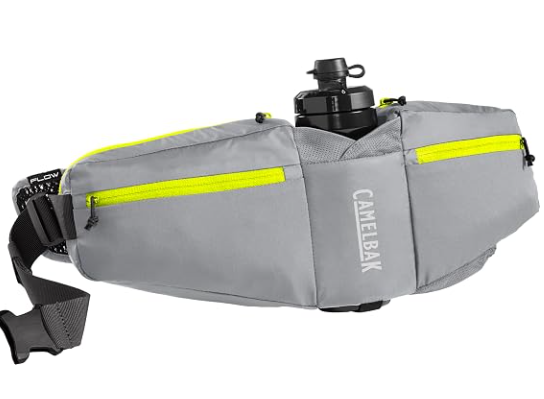
Best for: Runners, hikers, and cyclists who prefer one larger bottle and useful gear storage.
Key Features
- Includes a large CamelBak Podium bottle
- Approximately 21-ounce bottle capacity on current versions
- Adjustable waist buckle
- Secure bottle holster
- Zippered storage compartment
- Tool and small-item organization
- Breathable back/mesh construction
- Reflective details
The Podium Flow approach is different from the TrailMix: rather than using multiple small bottles, it places a larger bottle in an easily accessible angled pocket. Current listings describe the belt as a minimalist hip pack with a 21-ounce Podium bottle, secure bottle pocket, tool organization, zippered storage, and adjustable waist buckle.
Pros
- Larger single bottle is easy to refill
- Excellent for cycling and trail use
- Good storage for tools, snacks, and essentials
- Adjustable fit
- Bottle is quick to access
Cons
- One-sided bottle weight can feel less balanced
- Bulkier than a minimalist running belt
- Better suited to runners comfortable with a waist-pack format
Why We Recommend It
The Podium Flow Belt is particularly attractive if you do more than run. Its cycling-oriented design makes it useful for mountain biking, hiking, and travel as well as running. A long-running review found it lightweight and stable for riders who prefer carrying hydration and a small amount of gear without wearing a larger pack.
Choose this over the Nathan if you prefer a single larger bottle and want more of a compact hip-pack experience.
3. Salomon Pulse Belt

Best for: Minimalist runners who want a lightweight belt that can carry a flask and small essentials.
Key Features
- Four-way stretch construction
- Slip-on, tubular design
- Multiple storage pockets
- Rear stretch pocket suitable for a hydration flask
- Reflective details
- Low-profile construction
- No bulky buckle
- Designed for running, hiking, and other endurance activities
The Pulse Belt is a different category from traditional bottle belts. It is essentially a highly stretchable waist carrier that can accommodate a hydration flask while keeping the overall profile close to the body. One current specification listing gives the belt’s weight at about 62 grams for a small size and describes four pockets.
Pros
- Extremely lightweight
- Very low profile
- Comfortable for runners who dislike bulky belts
- Flexible storage arrangement
- Good choice for warm-weather running
Cons
- Less dedicated hydration capacity than bottle-focused belts
- Sizing is important because the belt has no traditional adjustment buckle
- Can become less comfortable when heavily loaded
Why We Recommend It
The Pulse Belt is ideal when you want your hydration gear to feel almost invisible. It is particularly useful for runners who already know they don’t need a large amount of water and prefer carrying a soft flask along with a phone, keys, gels, or other small items.
It is not our first choice for maximum hydration capacity, but it is one of the most appealing options for minimalist runners.
4. FlipBelt Hydration Belt / FlipBelt Elite


Best for: Runners who prioritize secure storage and a close-to-body fit.
Key Features
- Stretch fabric construction
- Multiple bottle access points on the dedicated hydration version
- Compatible with FlipBelt Arc bottles
- Moisture-wicking fabric
- Internal key storage
- Low-profile fit
- Elite version adds water-resistant storage
- Reflective trim on Elite model
The dedicated FlipBelt Hydration Belt uses multiple curved bottles rather than one large container. The bottles sit flush against the body, and the belt is designed to distribute hydration around the waist.
The FlipBelt Elite takes a slightly different approach, emphasizing secure storage and water resistance while still allowing a compact bottle to be carried. Its design includes a water-resistant pocket, anti-slip interior, moisture-wicking fabric, and reflective trim.
Pros
- Very secure, close-fitting design
- Excellent for carrying phones and small valuables
- Multiple access points
- Minimal external bulk
- Good choice for runners who dislike bouncing bottles
Cons
- Bottle capacity depends on the configuration
- Stretch fit may take some experimentation
- Not as suitable as a larger hydration pack for very long unsupported runs
Why We Recommend It
FlipBelt is a strong option for runners who view hydration as only one part of the problem. If you need a place for your phone, keys, cards, gels, and a small amount of water, the close-fitting design is compelling.
The hydration version is particularly useful when you prefer several smaller containers instead of one large bottle.
5. SPIbelt H2O Bottle One

Best for: Short runs, gym sessions, walkers, and runners who want a lightweight hydration solution without a large pack.
Key Features
- Compact running-belt format
- Dedicated bottle-carry configuration
- Adjustable waist strap
- Stretch storage
- Lightweight construction
- Designed for phones, keys, gels, and other small essentials
- Suitable for running and general workouts
SPIbelt’s broader range is known for lightweight stretch storage that keeps small items close to the body. The H2O configuration adds hydration without moving into the bulk of a hydration vest.
Pros
- Lightweight and compact
- Easy to use for shorter workouts
- Useful combination of hydration and storage
- Less bulky than many traditional waist packs
- Usually less expensive than premium multi-bottle belts
Cons
- Limited water capacity
- Not ideal for very long runs without refill access
- Less storage than larger hydration waist packs
Why We Recommend It
The SPIbelt H2O makes sense when your hydration needs are modest. If you are heading out for a short run, treadmill workout, walk, or gym session and simply want water plus a few essentials, carrying a large hydration belt can be unnecessary.
For longer endurance sessions, however, we’d spend more on a higher-capacity option such as the Nathan TrailMix or CamelBak Podium Flow.
Comparison Section
Nathan TrailMix Plus vs CamelBak Podium Flow vs Salomon Pulse Belt
The three leading choices represent three different approaches to hydration.
| Category | Nathan TrailMix Plus 3.0 | CamelBak Podium Flow | Salomon Pulse Belt |
| Hydration approach | Two 10 oz bottles | One larger bottle | Soft-flask-compatible stretch storage |
| Best use | Long runs and hot weather | Running, hiking, cycling | Lightweight running |
| Fit | Adjustable stretch belt | Adjustable buckle | Slip-on stretch |
| Storage | Front zip pocket + loops | Zip pocket + organization | Multiple stretch pockets |
| Weight distribution | Excellent with two bottles | More concentrated on one side | Very low overall load |
| Ease of access | Excellent | Excellent | Good |
| Minimalist feel | Moderate | Moderate | Excellent |
Size
The Salomon Pulse Belt is the most compact-feeling option. It hugs the body and avoids the hardware associated with traditional bottle belts.
The Nathan TrailMix is larger because it needs to accommodate two bottles and additional storage. That extra volume is worthwhile for longer sessions but unnecessary if you only need a few ounces of water.
The CamelBak sits between the two. It feels more like a small waist pack, but the larger bottle gives it an advantage when you don’t want to carry multiple small containers.
Adjustment Mechanism
The Nathan and CamelBak are easier to fine-tune because they use conventional adjustable systems. This is helpful when you are changing layers or carrying different amounts of gear.
The Salomon relies on stretch and sizing rather than a traditional buckle. That reduces bulk but makes choosing the right size more important.
Durability
All three come from established outdoor and running brands, but their construction priorities differ.
Nathan focuses on a dedicated hydration-belt format, CamelBak emphasizes hydration and utility, and Salomon prioritizes lightweight stretch construction. For repeated long-distance use, fit and how much you overload the belt will matter almost as much as the fabric itself.
Price
The Salomon is generally the most affordable way into a minimalist setup, while the Nathan and CamelBak typically cost more because they include dedicated hydration hardware and, in the Nathan’s case, multiple bottles.
Rather than choosing solely by sticker price, consider how much hydration you actually need. Paying more for capacity you never use isn’t a good value.


Buying Guide: How to Choose the Right Hydration Belt
A hydration belt should solve a simple problem: carrying enough fluid and essential gear without becoming a distraction.
The best model for a five-mile neighborhood run may be completely different from the best choice for marathon training or a three-hour hike.
Weight Range
Unlike adjustable dumbbells or other strength equipment, hydration belts don’t have a meaningful “weight range.” What matters is how much water and gear the belt can comfortably carry.
Water is heavy. A liter of water weighs roughly one kilogram before accounting for the bottle itself. As you increase capacity, stability and weight distribution become increasingly important.
For beginners and shorter workouts, around 300–600 ml may be plenty if you have access to water along the route.
For longer training runs, 600–750 ml or more may make sense depending on the weather, duration, pace, and availability of refill points.
For very long unsupported outings, a hydration vest or larger pack may be a better solution than simply putting more weight on a belt.
See our guide to the best home gym equipment for small spaces
Adjustment Mechanism
There are two common approaches.
Adjustable buckle belts use a strap and buckle to let you change the circumference. They are versatile and convenient if you change clothing layers or frequently vary how much you carry.
Stretch or slip-on belts eliminate bulky hardware. They can feel exceptionally comfortable and stable when correctly sized, but choosing the right size is more important.
For most first-time buyers, an adjustable model is the safer choice because it offers more flexibility.
Bottle Placement
Bottle placement affects comfort more than many buyers expect.
Multiple small bottles can distribute weight across the hips. This is one reason dedicated running belts often use two bottles instead of one large bottle. Runner’s World notes that water is one of the densest items runners carry and that distributing bottles around the waist can help with weight management.
A single bottle can be simpler to refill and drink from, but it concentrates weight on one side.
If you notice your belt twisting or bouncing, experiment with how tightly it is fitted and where the bottle sits before assuming the belt itself is defective.
Size and Storage
Consider what else you need to carry.
At minimum, many runners want space for:
- Smartphone
- Keys
- Identification
- Energy gels
- Earbuds
- Small first-aid items
- Cards or cash
A minimalist belt may be perfect if you carry only a phone and one flask. For longer outings, a larger zippered compartment can be worth the additional bulk.
If you live in an apartment or have limited storage space, a low-profile belt also has a practical advantage: it takes up almost no room when you’re not using it.
Read our guide to the best home gym equipment for small spaces
Durability
Look for strong stitching, quality zippers, reliable bottle holders, and fabrics designed to handle repeated exposure to sweat and washing.
Stretch materials should recover their shape rather than becoming loose after repeated use. Bottle holsters deserve particular attention because they experience constant movement and repeated insertion and removal.
Reflective details are another useful feature if you regularly run early in the morning or after dark.
Comfort and Bounce
A hydration belt can have excellent specifications and still be a bad purchase if it bounces.
The ideal belt should sit securely around your natural waist or hips without requiring excessive tightening. Over-tightening can create pressure points, while a loose belt allows the bottles to move with every stride.
Before your first long run, test the belt on a shorter workout. Fill the bottles to the level you normally carry and make sure the phone and other gear are secured.


Hydration Belt vs Hydration Vest
A belt is usually best when you want a compact solution and relatively modest hydration capacity.
A vest becomes more attractive when you need several liters of water, extra clothing, substantial nutrition, or equipment for remote trails. Hydration vests distribute weight across the torso and generally offer more total carrying capacity.
As a rule:
- Short runs: minimalist belt
- Medium-distance runs: dedicated hydration belt
- Long unsupported runs: hydration belt or vest depending on capacity
- Trail runs with extra equipment: hydration vest
- Cycling: waist pack or cycling-specific hydration belt
FAQs
Are hydration belts worth it?
Yes, if you want hands-free hydration without wearing a backpack or vest. They are especially useful for runners who need more than a handheld bottle but don’t need several liters of water.
How much water should a beginner carry?
For a short workout with reliable access to water, a small bottle may be enough. For longer runs, heat, or routes without refill points, carrying more water becomes increasingly important. Your actual fluid needs depend on duration, weather, intensity, and individual sweat rate.
Are hydration belts safe?
A properly fitted hydration belt is generally a practical way to carry fluids while exercising. The key is to avoid excessive bouncing, chafing, or carrying more weight than necessary. Test the belt during shorter workouts before relying on it for a long race or remote trail.
Do hydration belts save space?
Yes. A belt takes considerably less storage space than a hydration vest or backpack, making it convenient for home gyms, apartments, travel, and short outdoor workouts. Most can be rolled, folded, or stored in a small drawer when not being used.
Is a hydration belt better than a hydration vest?
Neither is universally better. A belt is usually lighter and less restrictive, while a vest offers considerably more capacity and storage. Choose the belt if you need a small amount of water and essentials; choose a vest when you need multiple liters or substantial equipment.
What is the best hydration belt for long-distance running?
For many runners, the Nathan TrailMix Plus 3.0 is the strongest all-around choice because it combines two 10-ounce bottles with useful storage and an adjustable fit. Fleet Feet specifically highlights the TrailMix’s two-bottle configuration, while Runner’s World has also rated the TrailMix Plus 3.0 highly for hydration-focused running.
Final Verdict
For most buyers, the Nathan TrailMix Plus 3.0 is the best hydration belt because it strikes a practical balance between capacity, stability, storage, and accessibility.
Choose the CamelBak Podium Flow if you prefer one larger bottle and want a belt that works especially well for cycling and hiking. Choose the Salomon Pulse Belt if your priority is an ultra-light, low-profile design. The FlipBelt Hydration Belt is a strong alternative for secure, distributed storage, while the SPIbelt H2O makes sense for shorter and lighter workouts.
The best hydration belt isn’t necessarily the one with the most pockets or largest bottles. It is the one that carries enough water for your workout, stays securely in place, and is comfortable enough that you stop thinking about it once you start moving.