Best Bike Lock for Bikepacking: 5 Reliable Options for Security on the Road
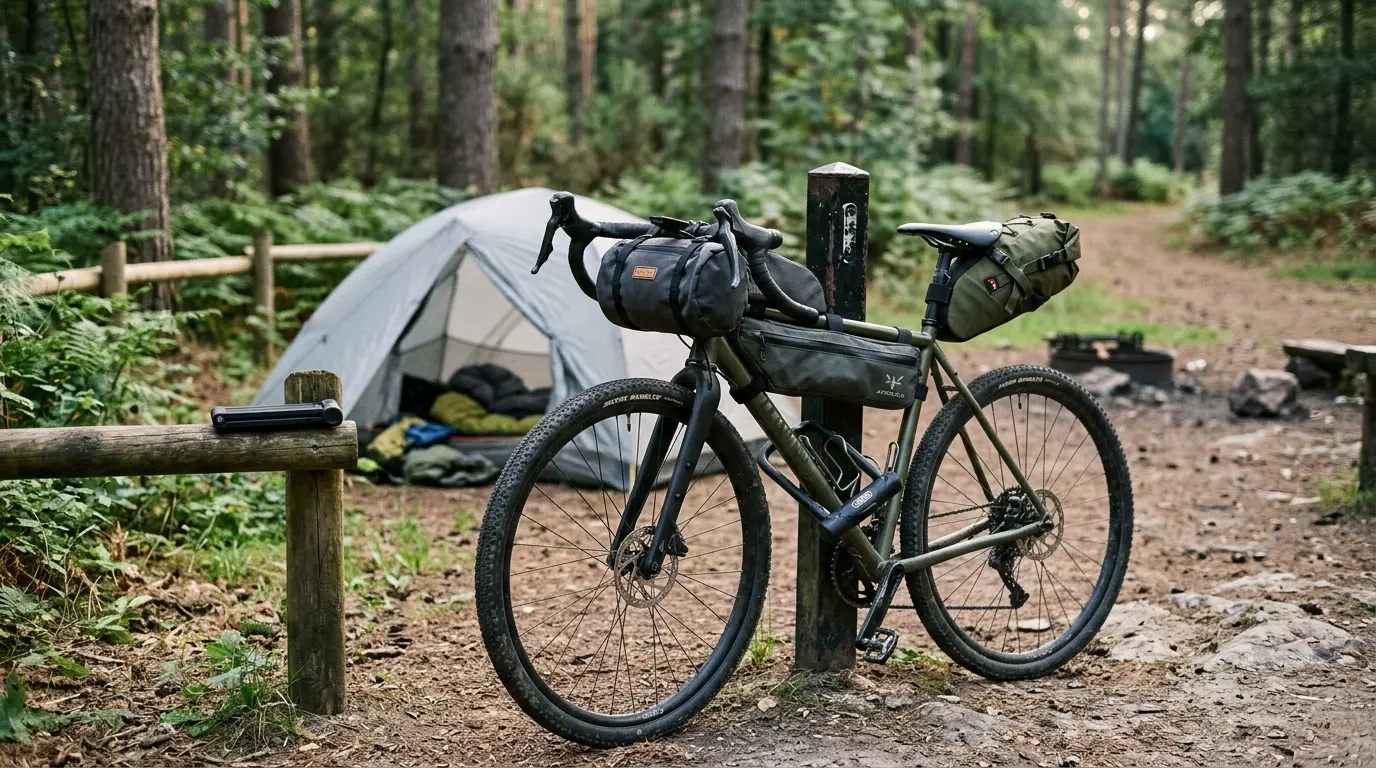
Bikepacking combines long-distance cycling, remote adventures, and overnight stops, which makes choosing the right bike lock more important than it might seem. Whether you’re leaving your bike outside a campsite, locking it up while exploring a town, or protecting an expensive touring setup, the best bike lock for bikepacking should balance security, weight, portability, and ease of use.
The challenge is finding a lock that provides meaningful theft protection without adding unnecessary bulk to your luggage. A heavy-duty chain might be ideal for overnight stops in busy cities, while a compact folding lock or lightweight cable may be more practical for remote routes where carrying weight matters.
This guide compares five popular bike-lock options, explains their strengths and limitations, and helps you choose the right level of security for your next adventure.
The Kryptonite Evolution Mini-7 with FlexFrame-U bracket is a strong all-around choice for bikepackers who want a practical balance of security, portability, and everyday convenience. Its hardened-steel U-lock design provides a more substantial barrier than a basic cable lock, while its compact form makes it easier to carry on a touring bike than many full-size chains. It is particularly suitable for riders who regularly stop in towns, travel through populated areas, or leave their bikes unattended during meals and overnight stays.
If minimizing weight is your highest priority, the ABUS Bordo Lite 6055 is worth considering for its compact folding format. Riders who need more flexibility around larger racks and fixed objects may prefer the Hiplok D1000, while the Kryptonite New York Fahgettaboudit Mini is a better fit for higher-risk urban stops where maximum practical resistance matters more than weight. For low-risk situations and brief stops, the ABUS Combiflex offers a convenient secondary security option, but it should not be treated as a primary theft deterrent.
For most bikepackers, the smartest approach is to choose a primary lock based on the places where the bike will be left unattended, then add a lightweight secondary lock if the wheels or accessories need extra protection.
Quick Comparison of the Best Bike Locks for Bikepacking.
| Product | Best For | Weight / Portability | Lock Type | Key Feature | Price | Check Price |
| Kryptonite Evolution Mini-7 | Best overall balance | Moderate; compact U-lock | Keyed U-lock | Hardened-steel shackle and included cable | Mid-range | View on Amazon |
| ABUS Bordo Lite 6055 | Weight-conscious touring | Lightweight folding format | Folding lock | Folds into a compact package | Mid-range | View on Amazon |
| Hiplok D1000 | High-risk urban stops | Heavy relative to its size | Compact U-lock | Specialized anti-angle-grinder construction | Premium | View on Amazon |
| Kryptonite New York Fahgettaboudit Mini | Maximum practical security | Heavy and compact | Heavy-duty U-lock | Thick, hardened-steel shackle | Premium | View on Amazon |
| ABUS Combiflex | Brief stops and secondary security | Very light and compact | Retractable cable lock | Convenient self-retracting cable | Budget to mid-range | View on Amazon |
Product Reviews: Best Bike Locks for Bikepacking
1. Kryptonite Evolution Mini-7
Best for: Bikepackers who want dependable primary security without carrying a full-size heavy-duty chain.
Key Features
- Hardened-steel U-lock construction.
- Compact shackle that is easier to transport than many large locks.
- Key-operated locking mechanism.
- FlexFrame-U mounting bracket on applicable packages.
- Included cable on the Mini-7 package for supplementary wheel security.
- Suitable for locking the frame to an appropriate fixed object when the geometry allows.
Pros
- Offers a stronger primary-locking approach than a basic retractable cable.
- Compact shape is relatively easy to fit around a frame or into luggage.
- The included cable can help secure a wheel when used appropriately.
- Practical for mixed trips involving campsites, villages, cafés, and larger towns.
- Familiar U-lock design is straightforward to use.
Cons
- The short shackle may not fit every rack, post, or frame-and-wheel combination.
- Heavier and less flexible than ultralight cable locks.
- The included cable should not be relied on as the main theft deterrent.
- Mounting brackets may be inconvenient on some frame bags or heavily loaded bikes.
Why We Recommend It
The Evolution Mini-7 earns its place as the all-around recommendation because it prioritizes useful security without becoming as cumbersome as a large chain. Bikepacking often involves changing environments: a quiet campsite one night, a busy town the next morning. A compact U-lock is a sensible compromise for these mixed conditions.
Before buying, measure the available locking space on your bike and check the shackle’s internal dimensions. A secure lock is only useful when it can connect your frame to a genuinely immovable object.
2. ABUS Bordo Lite 6055
Best for: Weight-conscious bikepackers who need a compact lock for moderate-risk stops.
Key Features
- Folding-link design.
- Compact storage when folded.
- Dedicated mounting solution on compatible versions.
- Key-operated locking on applicable models.
- Easier packing than many long chains.
- Designed for riders who value portability and tidy storage.
Pros
- Folding construction packs neatly into a frame bag or compatible mount.
- More versatile around certain racks and objects than a short U-lock.
- Convenient for touring bicycles with limited luggage space.
- Avoids the loose, tangled shape of many traditional chains.
- Offers a useful compromise between portability and everyday locking convenience.
Cons
- Its lightweight construction involves a security trade-off compared with more substantial heavy-duty locks.
- Folding joints create additional structural points compared with a simple solid shackle.
- The compact format still needs sufficient reach to secure the frame properly.
- It is not an ideal choice for every high-theft urban environment.
Why We Recommend It
The Bordo Lite 6055 is appealing when carrying less weight is a central part of the trip. A bikepacker may spend most of the day riding remote gravel routes and need a lock mainly for occasional food stops, shops, or overnight accommodation.
Its folding shape can be easier to pack than a rigid U-lock, particularly when a frame bag is already crowded with repair tools and camping equipment. However, lightweight construction should not be confused with maximum theft resistance. Choose it according to your actual exposure to theft, and consider a more robust primary lock for expensive bicycles left in busy public places.
3. Hiplok D1000
Best for: Bikepackers with expensive bicycles who regularly stop in theft-prone urban areas.
Key Features
- Compact U-lock format.
- Specialized composite material engineered to resist angle-grinder attacks.
- Hardened locking components.
- Key-operated mechanism.
- Designed around high-security use rather than minimum carrying weight.
- Compact dimensions that can work well with suitable frame mounts or luggage.
Pros
- Specifically designed to raise the difficulty of common angle-grinder attacks.
- Compact enough to carry on many touring and bikepacking setups.
- A useful option for expensive bicycles and high-risk stops.
- Provides a more security-focused alternative to lightweight travel locks.
- Can be paired with sensible parking practices for improved overall protection.
Cons
- Expensive compared with conventional folding and U-lock options.
- Heavy for riders who count every gram.
- Compact dimensions can restrict the range of objects it can secure.
- Specialized construction does not make any lock impossible to defeat.
Why We Recommend It
The Hiplok D1000 is aimed at riders who are unwilling to compromise heavily on security simply to save weight. If your bike represents a significant financial investment, or if your route includes major cities where power-tool attacks are a realistic concern, its specialized construction may justify the extra cost and carrying weight.
It is less compelling for a trip spent almost entirely on remote trails with secure overnight storage. The extra investment makes the most sense when your parking environment warrants it. Also check the usable internal locking space before purchase, especially if you ride a large-frame bike with wide tires or unusual frame geometry.
4. Kryptonite New York Fahgettaboudit Mini
Best for: Riders prioritizing substantial conventional U-lock construction over minimal pack weight.
Key Features
- Thick, hardened-steel shackle.
- Heavy-duty keyed locking system.
- Compact Mini format.
- Designed for demanding security applications.
- Can secure a frame and wheel when the object and available space permit.
- Suitable for pairing with a separate wheel lock or cable.
Pros
- Substantial construction makes it a serious primary-lock candidate.
- Compact shape avoids the extra length and bulk of a large chain.
- A practical option for expensive bikes in exposed urban locations.
- Can complement a second security device for wheels or accessories.
- Well suited to riders who consider theft prevention more important than grams saved.
Cons
- Heavy relative to many bikepacking accessories.
- The small internal opening limits locking flexibility.
- May be difficult to fit around a frame, wheel, and thick fixed object simultaneously.
- Less convenient for riders whose priorities are fast stops and lightweight luggage.
Why We Recommend It
The Fahgettaboudit Mini is designed for riders who want a robust conventional U-lock and are prepared to carry the weight. It is particularly relevant for journeys that combine remote riding with overnight stays in busy cities, where a bike may need to remain locked for several hours.
The main trade-off is its compact opening. Before committing to this model, test the dimensions against your bicycle and the types of racks or posts you expect to encounter. A larger lock can be more versatile, but a smaller opening can reduce the space available for leverage attacks. Parking choices and correct locking technique remain important regardless of the lock.
5. ABUS Combiflex
Best for: Brief low-risk stops and supplementary protection for helmets, bags, or accessories.
Key Features
- Retractable cable design.
- Compact body that fits easily into a small bag.
- Combination-based locking on applicable versions.
- Quick deployment and retraction.
- Useful for discouraging casual interference.
- Convenient as a secondary device alongside a stronger primary lock.
Pros
- Very easy to pack.
- Adds little bulk to a bikepacking kit.
- Quick to use during short stops.
- Can help secure accessories against opportunistic grabbing.
- Avoids the weight and storage requirements of a full-size primary lock.
Cons
- Thin cable is vulnerable to cutting tools.
- Provides limited protection against a determined bicycle thief.
- Should not be used alone to secure an expensive bicycle in a high-risk area.
- Cable length and locking details vary by model.
Why We Recommend It
The Combiflex is best understood as a convenience accessory, not a substitute for a proper bicycle lock. It can be useful when you are taking a quick break, securing a helmet to your bike, or adding a small extra obstacle to the theft of a removable accessory.
For overnight stops, unattended bicycles, and expensive touring setups, pair it with a more substantial primary lock. That combination can make sense for bikepackers who want to secure multiple items without carrying a second heavy U-lock.
Comparison — Kryptonite Evolution Mini-7 vs. Hiplok D1000 vs. ABUS Bordo Lite 6055
These three locks address different bikepacking priorities. The Evolution Mini-7 is the balanced option, the Hiplok D1000 focuses on high-security urban use, and the Bordo Lite 6055 emphasizes compact portability.
| Category | Kryptonite Evolution Mini-7 | Hiplok D1000 | ABUS Bordo Lite 6055 |
| Primary strength | Balanced security and portability | Specialized resistance to angle grinders | Lightweight folding convenience |
| Carrying comfort | Moderate | Heavy for its size | Generally best for weight-conscious riders |
| Locking flexibility | Limited by U-lock opening | Limited by compact U-lock opening | Folding links can adapt to different shapes |
| Urban security | Sensible for many everyday situations | Strong candidate for higher-risk environments | Better suited to situations where portability is a priority |
| Price level | Mid-range | Premium | Mid-range |
| Ideal buyer | General bikepacker | Security-focused urban traveler | Minimalist touring rider |
Size and portability
A U-lock has a fixed opening, which makes dimensions particularly important. The Evolution Mini-7 and D1000 can be easy to carry, but their compact openings may not fit every rack or post. The Bordo Lite folds into a smaller bundle and can be easier to store alongside camping gear.
For long gravel routes, consider not only the lock’s published weight but also how it attaches to the bicycle. A lock that rattles against a frame or takes up space needed for food and repair equipment can quickly become frustrating.
Adjustment and locking mechanism
Unlike adjustable gym equipment, bicycle locks do not have an adjustment mechanism in the usual sense. The meaningful distinction is between a rigid U-lock and a folding-link design.
A U-lock has a fixed shape and can be quick to position when a suitable anchor is available. A folding lock bends around objects, potentially offering more options at crowded bike racks. The trade-off is that the folding design contains multiple joints, and its security depends on its specific construction and independent testing.
Durability and security
The D1000’s specialized anti-angle-grinder design makes it particularly relevant for riders who leave expensive bikes in high-risk areas. The Evolution Mini-7 offers a more conventional balance of everyday security and portability. The Bordo Lite is attractive when weight matters, but it should be chosen with a realistic understanding of its intended security level.
No lock is theft-proof. A good locking strategy combines a suitable lock, a secure anchor, thoughtful parking, and limited exposure time.
Price and overall value
The Evolution Mini-7 is a practical starting point for many riders. The D1000 may be worth its premium if the bike’s value and parking environment justify the added investment. The Bordo Lite is appealing to riders who would rather save weight and accept a more limited security profile.
For additional advice on equipment choices, see our related guide to best home gym equipment for small spaces, or browse the site’s bikepacking and cycling gear guides when available.
Buying Guide: How to Choose the Best Bike Lock for Bikepacking
Weight and packability
Every item carried on a bikepacking trip competes for space and weight. A compact lock may be enough for occasional stops in low-risk locations, while a more substantial lock makes sense for expensive bikes and overnight urban parking.
When comparing options, look beyond the advertised weight:
- Check whether a mounting bracket is included.
- Consider whether the lock fits inside your frame bag.
- Make sure it does not interfere with water bottles, cables, or bags.
- Test for rattling and frame contact on rough roads.
- Decide whether carrying a primary and secondary lock is worthwhile.
A lock that is easy to access is more likely to be used consistently.
Security rating and intended use
There is no single security level that suits every trip. Consider where you will park, how long the bicycle will remain unattended, and how expensive it would be to replace.
For remote daytime stops, a moderate-security primary lock may be adequate depending on local risks. In busy cities, outside hostels, or at exposed overnight parking locations, a more substantial lock is generally a better choice.
Check the manufacturer’s security rating and the testing scheme behind it. Ratings from different organizations are not always directly comparable, so avoid relying on a numerical score alone.
Lock type: U-lock, folding lock, chain, or cable
U-locks: These use a rigid shackle and are often a good balance of portability and security. Their main drawback is limited reach.
Folding locks: These pack neatly and can fit around a wider variety of objects. Weight and resistance vary considerably between models.
Chain locks: A suitably hardened chain can provide greater flexibility around larger objects, but it can be heavy and awkward to carry over long distances.
Cable locks: These are light and convenient, but thin cables offer limited protection against cutting. Use them primarily for accessories or as secondary security.
For many bikepackers, a compact U-lock is the most straightforward primary option, while a folding lock is attractive when flexible placement and tidy storage matter more.
Size and compatibility
Before purchasing, check the internal dimensions of the lock against your bicycle’s frame, wheel, and typical parking anchors. A compact lock that cannot fit around the frame and an immovable object is of limited practical use.
Whenever possible, secure the frame and, if space allows, a wheel to a fixed object. If you cannot include both wheels, use a secondary lock or a secure wheel-retention system to reduce the risk of opportunistic theft.
Avoid locking to objects that can be lifted over, easily dismantled, or removed from the ground.
Durability and weather resistance
Bikepacking exposes equipment to rain, mud, dust, vibration, and temperature changes. Look for a lock with corrosion-resistant components, a protective coating, and a locking mechanism that can tolerate regular outdoor use.
After riding in wet or muddy conditions, wipe away dirt and allow the lock to dry. Follow the manufacturer’s maintenance instructions and use only a compatible lock lubricant. Keep the key or combination accessible, and test the mechanism periodically rather than discovering a problem at the end of a long day.
Keyed versus combination locks
Keyed locks can offer robust construction, but losing the key while traveling creates an obvious problem. Carrying a spare key separately from the main one is a sensible precaution.
Combination locks eliminate the need for a key, although convenience and security depend on the specific design. Choose a combination you can remember, avoid sharing it unnecessarily, and confirm that the lock can be operated reliably in poor weather.
Budget and replacement value
A useful rule is to consider the cost of replacing your bicycle and essential equipment, not simply the purchase price of the lock. A premium lock can be justified for a high-value bicycle or a route involving regular urban overnight stops.
However, the most expensive model is not automatically the best choice. A practical, well-used lock that fits your bike and your parking habits can be more valuable than a heavy security device that you leave behind because it is inconvenient.
Recommended setup for different bikepacking trips
| Trip Type | Suggested Setup | Main Consideration |
| Remote gravel and wild camping | Compact primary lock suited to local risks | Weight and reliable storage |
| Mixed rural and urban touring | Mid-range U-lock or suitable folding lock | Flexibility and everyday security |
| Expensive bike with city overnight stays | High-security primary lock plus accessory security | Theft risk and replacement cost |
| Lightweight overnight adventure | Compact lock and careful parking | Minimum practical carrying weight |
| Hostel or campsite travel | Primary lock matched to available anchors | Secure fixed objects and storage options |
The best setup is the one that matches the real risks of your route. When possible, store the bicycle indoors overnight and use the lock as an additional precaution rather than relying on it as your only defense.
FAQs
What is the best bike lock for bikepacking?
For many riders, the Kryptonite Evolution Mini-7 is a practical all-around choice because it balances conventional U-lock security with manageable portability. Riders who prioritize weight may prefer a folding lock, while those who regularly park expensive bikes in high-risk urban areas may want a more specialized high-security option.
Are lightweight bike locks safe enough for bikepacking?
They can be suitable for brief stops in lower-risk locations, but lightweight construction often involves security compromises. A thin cable lock should not be the only protection for an expensive bike left unattended for an extended period. Match the lock to your parking environment and the potential cost of theft.
Should I carry two bike locks on a bikepacking trip?
Carrying two locks can make sense when you need to secure the frame and wheels or want a secondary device for accessories. One substantial primary lock and one lightweight secondary lock can provide a useful balance without the bulk of two heavy security devices. The right combination depends on the bicycle, route, and available storage.
Is a U-lock better than a folding lock for bikepacking?
Neither type is universally better. A U-lock offers a rigid design and can be an excellent primary lock, but its fixed opening limits where it can fit. A folding lock is more adaptable to some parking situations and often packs neatly, although security varies by model.
How do I lock my bike safely overnight?
Whenever possible, store the bike in a locked room or another secure indoor location. If it must remain outside, connect the frame and a wheel to a solid, immovable anchor, choose a visible location, and avoid leaving removable valuables attached. For higher-risk locations, use a stronger primary lock and consider additional wheel security.
Can I use a cable lock as my only bikepacking lock?
A thin cable lock is best treated as a secondary deterrent rather than a primary security device. It may help secure a helmet or discourage casual interference during a very brief stop, but it can be vulnerable to cutting tools. For overnight stops or expensive bicycles, choose a more substantial primary lock.
Final Verdict
The best bike lock for bikepacking is not necessarily the heaviest or most expensive model. It is the one that provides an appropriate level of security for your route while remaining practical to carry every day.
For most mixed-route bikepackers, the Kryptonite Evolution Mini-7 is a sensible starting point. The ABUS Bordo Lite 6055 is worth considering when packability is the priority, the Hiplok D1000 suits riders who need specialized high-security protection, and the Kryptonite New York Fahgettaboudit Mini is a compelling option for those willing to carry a heavy-duty conventional lock. The ABUS Combiflex is best reserved for secondary security and brief, low-risk stops.
Before buying, confirm the exact model, dimensions, weight, mounting compatibility, and security rating. Pair the right lock with good parking habits, and you will be better prepared to protect your bicycle throughout your next bikepacking adventure.